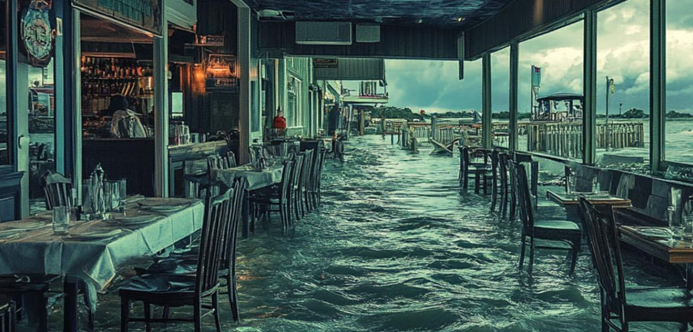
Climate change is an existential threat to the restaurant industry 2024
Operators and many industry experts agree that rising temperatures, increasing weather-related disasters and other looming environmental concerns pose huge risks to restaurants. Here’s what they’re doing about it.
Nov. 11, 2024

Climate change represents an existential threat to the restaurant industry, especially to independent restaurants.
That’s not hyperbole, said Dan Jacobs, co-owner of Milwaukee’s EsterEv and DanDan.
“If things aren’t changed, we are going to see the end of independent restaurants,” Jacobs said. “Independent restaurants are the fabric of our communities.”
Rising temperatures, unpredictable and destructive weather events, wildfires, a looming water crisis and more have the potential to disrupt nearly every aspect of a restaurant’s operations.
In recent weeks, restaurants were wiped out by Hurricanes Helene and Milton in the Carolinas, Florida, Georgia, Virginia and Tennessee. That’s a headline-making impact of climate change.
But climate change is leaving its mark on virtually every aspect of the restaurant industry:
- Earlier this year, Phoenix recorded 113 consecutive days over 100 degrees, putting a damper on outdoor dining and driving up energy costs to keep restaurants cool
- A Thai chef in Los Angeles reports that the soil is too warm to grow cilantro root, an essential ingredient in curry paste, forcing her to substitute ingredients and compromise on flavor
- High temperatures require refrigerator compressors to work overtime, leading to more equipment breakdowns
- An inconsistent supply chain can lead to elevated prices which, in turn, can drive diners away
- Employees may need to miss work to deal with a home hit by flooding or children out of school due to soaring temperatures
“There’s a very clear and direct link between climate change and the economic health of restaurants,” said Anne McBride, vice president of programs at the James Beard Foundation (JBF).
For the next five days, Restaurant Business will look at the ways the industry is being shaped by the changing climate, and how some operators and advocates are fighting to stem the losses. We’ll examine the promise of regenerative farming, how some are combating food waste, innovative ways restaurants are saving energy, the impact of soaring insurance rates and more.
“There’s a real urgency,” McBride added. “And when you see things like what happened in North Carolina, for example, in Asheville, seeing that kind of destruction, seeing the number of closures … [Or] the number of restaurants that have closed in places like Colorado. When there’s less snow, people don’t come skiing. And you already have a very short season … So, that’s happening across the country. These extreme weather events are impacting restaurants.”
Both victims of climate change and causes of it
For restaurants, in particular, climate change is especially complex. And that’s because restaurants are both a victim of natural disasters, rising temperatures and water scarcity and they’re also a cause of it.
“Chefs and restaurants are, let’s say, charismatic victims of climate change,” said Barton Seaver, an award-winning chef who is now a sustainable seafood educator and advocate. “There’s the flipside of this which is where how are drivers of climate change? And not in a finger-wagging, sort of traditional environmental vantage point which is ‘bad human, bad.’ Restaurants are participants, willing or not, in a system that has been built for efficiency and lower cost rather than actual, measured and considered outcomes … How do we both gauge and come to grips with our role in creating the system, as well as use our levers as drivers of change to make it what we want?”
Entrepreneurs like to open restaurants and other businesses in areas with rapid population growth. In the U.S., that means the South and West, places like Florida, Phoenix, Houston and Dallas-Fort Worth. But those are also the areas at greatest risk for climate change-fueled weather disasters, according to a recent analysis by The New York Times. And that growth can strain infrastructure such as roads and electrical grids, amplifying the damages of severe weather.
Just over 4,200 natural disasters were recorded from 1980 to 1999, according to a 2020 United Nations Office for Disaster Risk Reduction report. But that number rose to 7,348 natural disasters from 2000 to 2019, with a 232% increase in extreme temperatures, 46% jump in wildfires, 134% increase in floods and 40% rise in storms, the report said. And those numbers have continued to climb in the last several years.
Rising temperatures are also suppressing the supply chain. With every 1.8 degrees Fahrenheit increase in global temperature, “extensive losses” occur in the production of wheat, rice, maize and soybeans, the staple grains that account for two-thirds of the world’s caloric intake, according to “The Climate Reality for Independent Restaurants,” a report published earlier this year by the James Beard Foundation and the Global Food Institute (GFI) at The George Washington University.
A reduction in crops will drive up prices, and extreme weather can roil the supply chain, increasing transit time and disrupting distribution.
“Climate change is an urgent threat that significantly affects our food supply chain, and this impact ripples through communities, economies, farmers, the fishing industry and restaurant owners alike,” the James Beard-GFI report stated. “As climate change disrupts traditional weather patterns, alters growing seasons, intensifies extreme weather events and leads to biodiversity loss, agricultural productivity and stability are jeopardized … This uncertainty affects the consistent and reliable sourcing of ingredients for restaurants.”
For Minneapolis-based Chef Sean Sherman, owner of Owamni and a member of the Oglala Lakota Sioux tribe, solutions lie in returning to indigenous food systems.
Sherman, widely known as the Sioux Chef, recently earned a spot on the Climate 100 list published by the U.K.-based newspaper The Independent for his work to “source local, wild and heirloom ingredients and follow the sustainable practices that Indigenous communities have used for generations.”
Colonizers devastated the land through logging, mining and other destructive practices. Sherman is working to counteract that by educating people about indigenous foodways that are more sustainable.
“It’s important to understand that, as we kind of crawl into some really devastating climate change issues and are facing major things like water crisis here in the United States, that strengthening our local food systems is really a must for us, especially from a restaurateur point of view, but just as a human in general,” Sherman said. “If we look at it from an indigenous lens, we can understand how to better utilize the landscapes around us and understand how we should be protecting a lot of our natural resources instead of endangering them.”
These are huge issues, to be sure, but Sherman is addressing them with a local approach.
Owamni, which comes from the Dakota word for turbulent water, whirlpool or eddy, is part of Sherman’s nonprofit organization North American Traditional Indigenous Food Systems (NATIFS), which works to create a food system that “generates wealth and improves health” in Native communities. The operation includes the Indigenous Food Lab in Minneapolis, with a retail space to sell indigenous products like maple syrup, wild rice, frozen meals, housemade tortillas, as well as a hot bar, tea bar, commercial kitchen and education studio.
“It’s one thing if I give somebody two pounds of dried corn, but will they know what to do with it in their home?” he said.
His award-winning restaurant (named the best new restaurant of 2022 by the James Beard Foundation among other accolades), with Saturday dinner reservations booked out for about a month, is the engine for Sherman’s broader vision. Owmani serves intensely regional and seasonal dishes, focusing on ingredients like wild rice, sweet potatoes, bison and elk.
“Our restaurant does very well,” Sherman said. “We make quite a bit of sales throughout the year. A big chunk of that is food costs, and a big chunk of that food cost is being spent directly on indigenous producers … Owamni really serves a purpose. It creates skill sets of hiring. We have 100 people working at Owamni throughout the year, and about 70% of our staff is identifying as indigenous. Because of our intentionality of purchasing from indigenous producers, we’re just moving a ton of money towards indigenous producers.”
For his next act, Sherman is looking at replicating his operation around the country, starting in Bozeman, Montana, and Anchorage, and expanding from there.
“There’s no purpose to live in fear,” Sherman said. “So, the best thing we can do is at least try to make the next generation stronger.”
Making the case on Capitol Hill
Individual operators like Sherman, and larger restaurant chains, can no doubt have an impact on climate change and related issues.
But lobbying elected officials for systems change is the most effective way to make process on these global issues, experts agree.
The James Beard Foundation launched its Climate Solutions for Restaurant Survival campaign early this year to mobilize restaurant owners to push their representatives in D.C. to slow the impacts of climate change.
The group has been holding roundtables with chefs and lawmakers around the country this year to highlight the economic impacts of climate change and will host a congressional briefing on Dec. 5.
Specifically, JBF is fighting for a version of the Farm Bill to include conservation funding for climate-smart agriculture and it is seeking to protect the $20 billion in climate-smart agriculture funding provided by the Inflation Reduction Act. Climate-smart agriculture addresses some of the problems caused by climate change through practices focused on building resilient systems by adapting growing operations to climate conditions.
“There’s not one solution,” the JBF’s McBride said. “There’s not one miracle, one miracle solution to solving anything having to do with climate change or its economic impact on restaurants … [We’re] focusing on the big picture of legislative change and also giving them operation-level solutions that are much more immediate.”
Communicating the cause to diners
Getting diners on board with issues related to climate change is another story, though.
But as the crisis intensifies, it may be up to restaurant operators to explain why meals cost more or why certain ingredients may no longer be on the menu. A consumer-facing campaign is next on the JBF’s agenda, McBride said.
“Diners don’t want to think about climate change when they’re going out for dinner,” she said. “They really don’t, so it’s very hard for them to understand why they’re suddenly paying a lot more for their dinner. They think chefs are lining their pockets. We know that’s anything but the truth.”
Cava remains industry outlier with double-digit traffic gains
The rollout of a new loyalty program and addictive Garlic Ranch Pita Chips helped boost third-quarter traffic nearly 13% at the fast-casual Mediterranean chain.
Nov. 12, 2024

A new loyalty program and Garlic Ranch Pita Chips helped Cava report yet another industry-busting quarter on Tuesday, with traffic up nearly 13%.
While most publicly traded restaurant companies struggle to hang onto their fans in a discount-flooded competitive landscape, Cava seems to be coasting along without coupons or meal deals to lure in diners.
For the Oct. 6-ended third quarter, same-store sales increased 18.1%, including a 12.9% increase in traffic, along with 5.2% from menu pricing and product mix.
That’s lapping a 14.1% increase in same-store sales in the third quarter last year, for a two-year increase of more than 32%.
The results exceeded Wall Street analysts expectations, sending the stock price up 15% in after-market trading.
“Mediterranean is meeting the moment,” said Cava Group Inc. CEO Brett Schulman during the earnings call on Tuesday.
He credited the strong results to a confluence of factors: the strength of a category-defining brand, the unique value proposition and good unit-level execution.
While other restaurant chains are leaning on technology and becoming “increasingly transactional,” Cava is focusing on “heart, health and humanity”—an oft-repeated phrase in Cava world.
Restaurants are being softened by pillows, plants and other comforts in an initiative called Project Soul, for example. And workers are empowered to hit the “Love Button” to give out free meals where they see the need to boost someone’s spirits.
“Our business is built on the idea of welcoming everyone to our table, and we are focused on creating the authentic human connections consumers are hungry for,” he said.
(A case in point, Los Angeles-based Cava fed both the Dodgers and the Yankees during the World Series, he said.)
During the quarter, Cava rolled out its long-awaited new loyalty program, which allows for more personalized marketing and gives guests a choice of how they want to use rewards. So far, loyalty sales as a percentage of revenue increased 200 basis points, Schulman said.
The loyalty program was rolled out in conjunction with the launch of the chain’s first flavored iteration of its fan-favorite pita chips. The new Garlic Ranch Pita Chips drove incremental attachments, and Cava is planning more flavors down the road, as well as beverage and dessert innovations.
Also rolling out earlier than expected during the quarter was Cava’s new labor scheduling model, which ensures the right staffing is in the right place at the right times.
In lower-volume restaurants, for example, the model has added labor, resulting in modest increases in sales and improvement in guest scores, said CFO Tricia Tolivar.
But mostly the labor technology has helped improve both speed and service, she said.
Cava’s average unit volume ticked up to $2.8 million, from $2.6 million a year ago, and margins also grew to 25.6%, compared with 25.1% a year ago.
The chain opened 11 restaurants during the quarter for a total of 352.
Net income was $18 million for the quarter, compared with $6.8 million a year ago, on revenues that increased 39% to $241.5 million.
Cava also raised its full-year guidance for the year (again). Now the company projects it will open 56 to 58 units this year (up from earlier projection of 54 to 57).
The company started 2024 year with projected increases of between 4.5% to 6.5%, and then in the second quarter upped that to 8.5% to 9.5%.
Now same-store sales are now expected to increase in double digits for the year, between 12% and 13%.
Tolivar noted that earlier guidance included considerations of potential headwinds from both macroeconomic challenges and election-related volatility.
With the election behind us, the updated guidance takes those headwinds out of consideration, she said.
Source ; restaurantbusinessonline
November 2024
Leave a Reply
You must be logged in to post a comment.