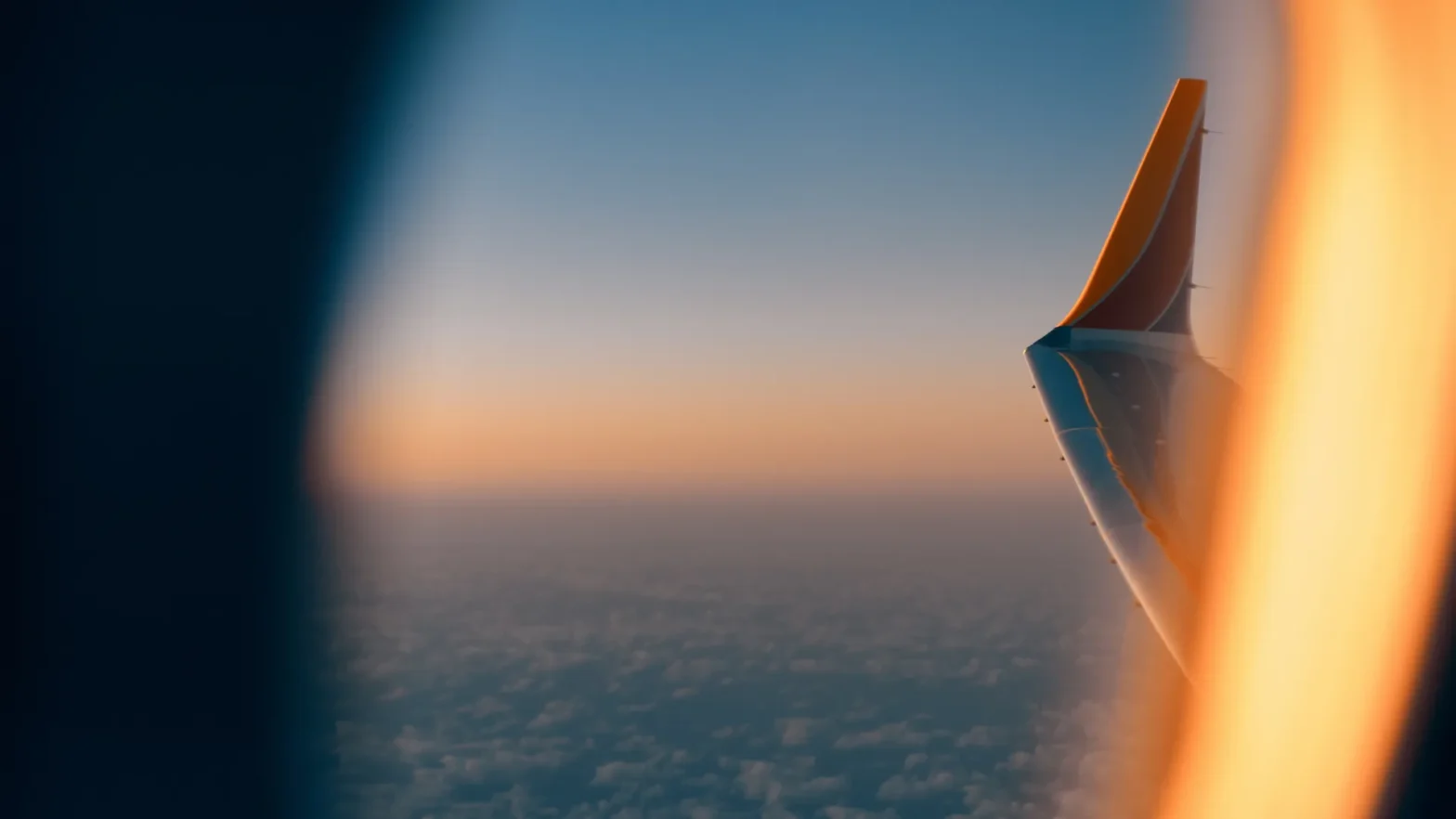
All your questions about about airplane turbulence, answered.
May 23, 2024

We’ve all been there. You’re cruising through the clouds at high altitude, excitement building for all your adventures ahead until—*ding*—the seatbelt sign flashes on, warning that the journey may be a little bumpier than you’d hoped.
But sometimes, turbulence is more severe than just a few bumps. On Tuesday, a Singapore Airlines flight hit “sudden extreme turbulence” at 37,000 feet, the company said in a statement, forcing the plane to make an emergency landing in Bangkok. The terrifying incident resulted in widespread injuries and one fatality, according to the airline. Kittipong Kittikachorn, the general manager of Bangkok’s Suvarnabhumi airport, said at a press conference that the 73-year-old British man likely died from a suspected hearth attack, Reuters reported.
According to the National Weather Service, severe turbulence is defined as “large and abrupt changes in altitude” usually accompanied by large variations in indicated airspeed that may cause an airplane to be “momentarily out of control.” Meanwhile, extreme turbulence is classified as when an “airplane is tossed violently about and is impossible to control,” potentially causing structural damage to the aircraft.
But how common is severe or extreme turbulence? How safe are we in the skies? And is turbulence occurring more frequently, or is evidence of it just easier to access than ever before?
To get to the bottom of it all, we turned to Isabel Smith of the University of Reading’s Meteorology Department, whose work involves using high-resolution climate models to predict increases in atmospheric turbulence.

What is turbulence?
Turbulence is the chaotic movement of air created by the shearing of winds or forced airflow up over mountains. The atmosphere is a large fluid, with waves of airflow propagating around the world. As the air becomes unstable, it breaks into fast-moving chaotic swirls. An aircraft encountering turbulence is shaken as it encounters fast-flowing, swirling airflow.
Is turbulence safe?
There is the possibility of encountering severe turbulence, which can be dangerous. However, it is extremely rare, with less than one percent of the atmosphere containing severe turbulence. You are much more likely to encounter light turbulence, which will shake you around and possibly spill over a few drinks—but it is not dangerous.
The issue with some types of turbulence, like clear air turbulence, is it can come out of nowhere, so you can be thrown while walking around the plane. This is why the best advice is to keep your seat belt on as much as possible.
Is turbulence happening more often?
Yes, turbulence is increasing with climate change. However, for the individual, you are more likely to be hit by longer flight routes, more delays, and longer waiting times at airports. Airlines will normally plan out the route with the least amount of turbulence. Avoiding turbulence will lead to longer and more convoluted flight paths.
Can a plane crash from turbulence?
If the plane was flying through an active thunderstorm, turbulence and other weather variables like downdrafts, heavy rainfall, and hail could lead to an incident. However, thunderstorms are very well forecasted, and an airline would not let you fly through an active thunderstorm, so you should not worry. Turbulence on its own would not lead to a plane crash.

Is there a link between climate change and an increase in turbulence?
Global warming refers to the rapid warming of the troposphere globally in time. The troposphere is the layer of the atmosphere closest to the surface which we live in. There are several layers within the atmosphere; the layer above the troposphere is the stratosphere. The increase in greenhouse gases traps heat within the troposphere, which would usually be emitted into the stratosphere. Therefore, the stratosphere is cooling at a rate similar to tropospheric warming. This creates a strong temperature difference vertically across the atmosphere.
What does this mean for turbulence? A stronger vertical temperature gradient leads to a more chaotic jet stream. As jet streams get stronger, it gets more chaotic and unstable, and the number of CAT (clear-air turbulence) encounters increases.
What are airlines doing to combat it?
CAT forecasts, which are like temperature and rain forecasts but just for turbulence, are around 70 to 80 percent accurate. Airlines plan out flight routes to try and avoid turbulence as much as possible. This often leads to longer flight times, longer wait times, increased use of fuel, and more emissions of CO2 into the atmosphere.
It’s been found that, assuming there’s no growth in the aviation industry in a future world with double the CO2 concentration as pre-industrial conditions, it will cost $2.2 million per year for the aviation industry to avoid CAT. These more convoluted flight routes would lead to an extra 70 million kilograms of CO2 by the aviation sector annually. The aviation industry is prominently researching the best way to reduce its CO2 emissions, with several ongoing studies. This is a general statement about all airlines. One initial approach could be to optimize flight routes. Another study found that by optimizing flight routes between December 2019 and February 2020, 6.7 million kg of CO2 could have been saved in that one season. However, the most optimal flight route may be the most turbulent.
In terms of what the aviation industry could do to avoid CAT, [it could] use these optimal flight routes and CAT forecasting tools to avoid it as much as possible. CAT, as previously mentioned, is not detectable with current onboard radar. A few studies have found LIDAR is a possible mechanism for detection. However, Kauffmann’s study found it was not cost-effective to implement LIDAR equipment in every aircraft—although this is an outdated study from 20 years ago.
Source : cntraveler
May 2024
Leave a Reply
You must be logged in to post a comment.