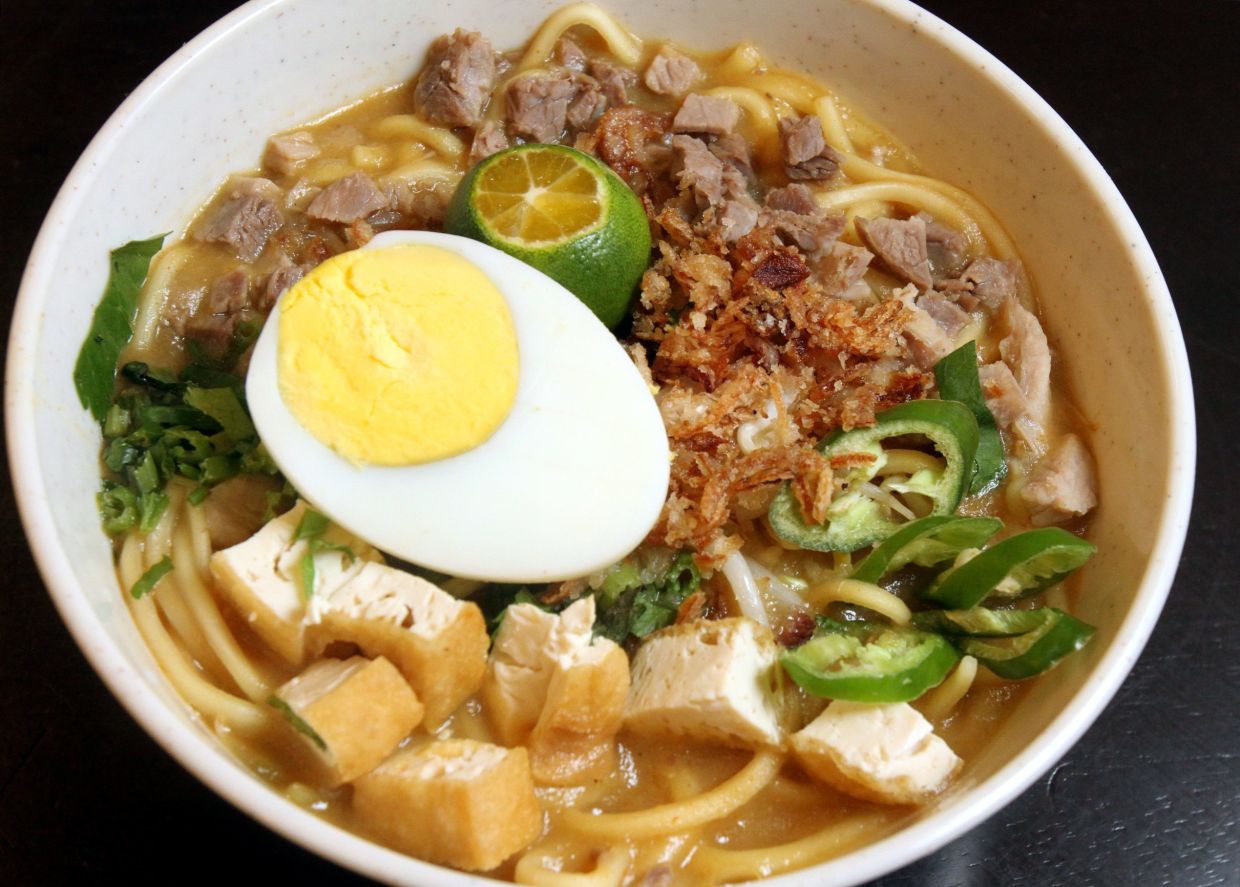
Noodles are a particularly popular staple in Malaysian cuisine, providing an alternative source of carbohydrates to rice. Noodles, whether stir-fried, steeped in gravy or soups, are ubiquitous throughout the country, with numerous localised variations prepared by the different ethnic communities according to their traditions and preferences.
Whenever I think of noodles or mi, three images appear in my mind – mi rebus badali from Johor Baru, Muar’s mi bandung and Sha’ari mi jawa in Penang. These are my favourite noodle dishes and were a part of my childhood and early years of my married life.
When we were living in Johor Baru in the early 1950s, my father would take us for dinner at a food court behind the Capitol cinema at Jalan Station, close to the train station.
It was a very simple food court with a zinc roof, some stalls and tables and chairs for customers, for them to eat in or order takeaways. There were a few pushcarts parked along the road selling beverages. There was no air conditioning so it was too hot to operate during the day.
It only became a hive of activity after 5pm to attract the after office and early dinner crowd. My father would order, without fail, the mi rebus, satay and freshly squeezed sugar cane juice.
Someone once asked me what was so special about this mi rebus, a concoction of fresh yellow egg noodles in a spicy, aromatic gravy of beef stock, sweet potatoes and fragrant spices, garnished with bean sprouts, slices of soya bean cakes, slices of hard-boiled eggs, chopped parsley and spring onions, fried shallots and a topping of crispy fried crackers or pendaram.
It was served with a dash of vinegar and dark soya sauce for an extra oomph. Today, this is one of Johor’s signature dishes.
The man responsible for the creation of this mi is Wak Baidali, who began selling his special version of mi rebus in 1918. In 1938, his son Haji Wahid took over the business. It is sometimes referred to as mi rebus baidali or mi Hj Wahid. The original versions are still being sold in Johor Bahru and branches have opened up in Kuala Lumpur, Shah Alam and Putrajaya by Haji Wahid’s grandsons.What is special about the mi rebus baidali is the gravy or kuah. The gravy is always the soul of mi rebus. His gravy is subtly fragrant with an aroma of dried shrimps. It is also thicker and nuttier than others due to the use of groundnuts.
The addition of the crispy crackers or pendaram, made from rice flour and blended dried shrimps, aromatics and spices provide a welcome tasty crunch against the smooth, rich flavoursome gravy – resulting in many of us referring to the crackers as “crook crook”, which is what chewing on them sound like.
The town where I was born, Muar, is famous for its mi bandung. In fact, Muar is the town where mi bandung is said to have originated, not Bandung in Indonesia.
The word ‘bandung’ means mixed, a mixture of yellow egg noodles in a thick savoury gravy with a hint of spices, with additional ingredients such as meat, prawns, fish cakes and mustard greens.
When I was teaching at the Muar High School in 1966, I would take my grandparents, Tok Mat and Tok Nah and my two aunties, Mak Nana and Cik Pati, at least once a month, for a mi bandung lunch at Restoran Mee Bandung Abu Bakar Hanipah on Jalan Abdullah. I remember I had to do two trips as I then had a Triump Spitfire sports car and it could only fit three persons.
I also remember craving for mi bandung when I was pregnant with my first daughter, Sharinaz, in 1968. We were then living in Teluk Datok, near the town of Banting. I called my Aunty Nana and she quickly arranged for the mi bandung to be delivered by taxi to my parents’ house at Lorong Stonor, in Kuala Lumpur where I was waiting anxiously. Teluk Datok was then an hour’s ride to Kuala Lumpur. I still remember slurping the gravy till the last drop. It was the best mi bandung that I had ever tasted.
It is really the gravy or kuah that is key to whether mi bandung is delicious or not. The beef slices and bones are boiled until tender and the stock is retained. The gravy paste is also important- the shallots, garlic, ginger and dried prawns have to be blended finely and mixed with chilli paste and then sauteed until the oil separates. It is then seasoned with oyster sauce, tomato sauce and fresh tomatoes, and simmered until all the ingredients are well combined.
Then add eggs and when half cooked, ladle them onto a plate. Prawns are then added and finally the mustard greens. Let the gravy simmer for a while. Pak Abu Bakar would place the yellow noodles on a plate, put the half-cooked egg and some pieces of prawns and garnish the dish with slices of beef, fried soya bean cake, chopped spring onions and parsley and fried shallots on top and gently pour over the gravy. He would serve it with pickled chillies on the side. Syok nya !!!
Another of my favourite noodle is Sha’ari mi jawa in Penang. I only discovered the existence of this mi after my marriage to Shafee in December 1966. Sha’ari is Shafee’s brother-in-law. He was married to Shafee’s eldest sister, Aishah, when she was fifteen. He was a municipal council worker by day and at night he operated his mi jawa stall at the corner coffee shop between Transfer Road and Dickens Street, just opposite what used to be the Penang State Police Headquarters.
Leave a Reply
You must be logged in to post a comment.